
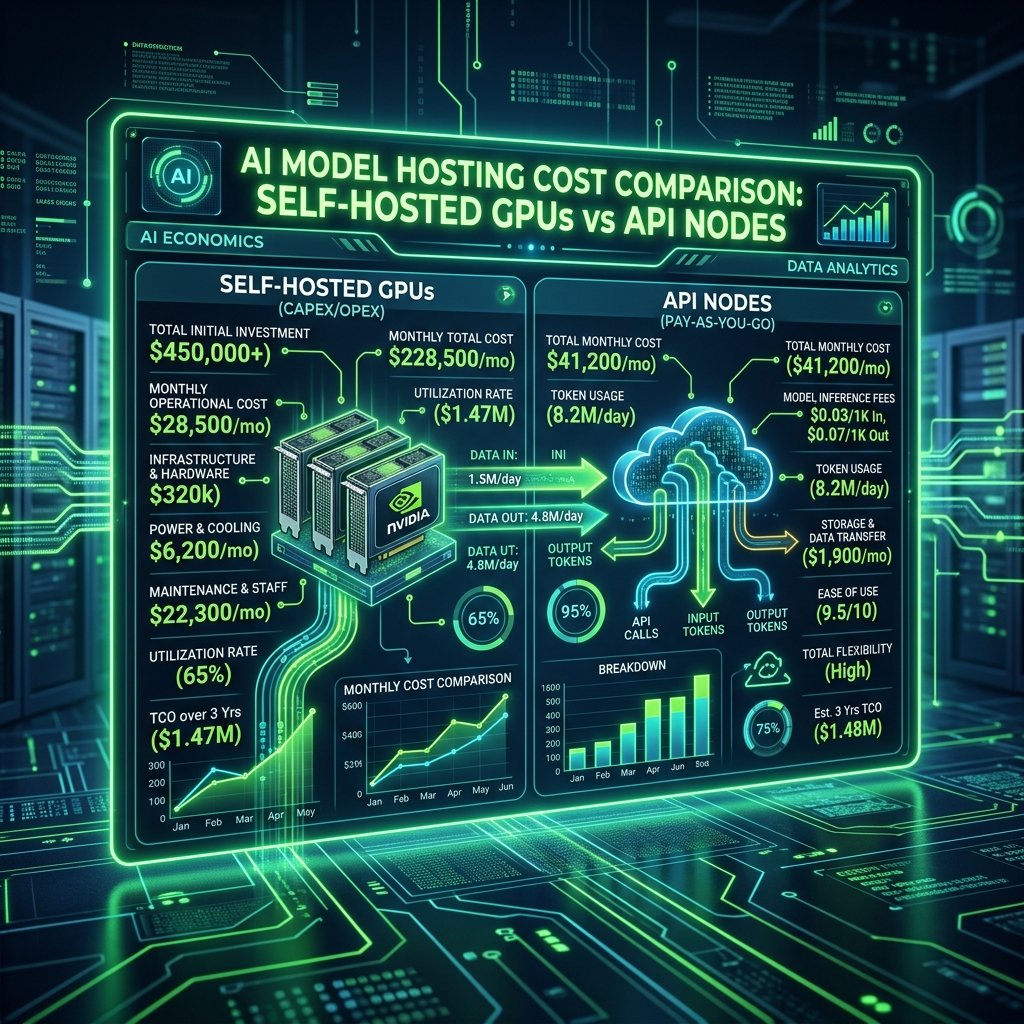
Over the past two years, open-source large language models (like Meta's Llama 3 and Alibaba's Qwen 2.5) have reached performance parity with commercial models. This has led many startup founders to consider moving away from closed APIs (like OpenAI's GPT-4o) to self-hosted instances. The promise is clear: lower token fees, complete data privacy, and no rate limits.
However, running high-performance models requires specialized hardware. Renting dedicated GPUs on cloud providers (like RunPod, Lambda Labs, or AWS) involves fixed hourly fees that accumulate regardless of actual model usage. In this article, we calculate the mathematical tipping point where self-hosting becomes cheaper than pay-as-you-go APIs.
1. Understanding the Pricing Models
Closed APIs utilize utility-based pricing: you pay only for the exact number of input and output tokens processed. In 2026, GPT-4o costs approximately $5.00 per million input tokens and $15.00 per million output tokens.
Self-hosting utilizes capacity-based pricing: you rent an instance (e.g. an NVIDIA A10G with 24GB VRAM) for a flat rate of around $0.80 per hour ($576 per month), regardless of whether you process one token or one billion tokens. If your application lies idle at night, you are still paying for the hardware allocation.
2. Cost Comparison Script in Python
To help our engineering team decide when to migrate, we wrote a Python utility that simulates daily token usage patterns and calculates the total monthly cost difference between API queries and GPU instances:
def calculate_tipping_point(daily_requests, avg_tokens_per_req):
    # API Costs per 1M tokens (GPT-4o standard in 2026)
    input_cost_per_m = 5.00
    output_cost_per_m = 15.00
    # Assuming 70% input / 30% output split
    avg_cost_per_m = (input_cost_per_m * 0.70) + (output_cost_per_m * 0.30)

    # Calculate monthly API cost
    monthly_tokens = daily_requests * avg_tokens_per_req * 30
    api_monthly_cost = (monthly_tokens / 1_000_000) * avg_cost_per_m

    # Self-hosting Costs (Renting 1x NVIDIA A10G 24GB)
    gpu_hourly_rate = 0.82
    monthly_gpu_cost = gpu_hourly_rate * 24 * 30

    print(f"Monthly Tokens: {monthly_tokens:,}")
    print(f"Monthly API Cost: ${api_monthly_cost:.2f}")
    print(f"Monthly GPU Cost: ${monthly_gpu_cost:.2f}")

    if api_monthly_cost > monthly_gpu_cost:
        savings = api_monthly_cost - monthly_gpu_cost
        print(f"[+] Recommendation: Migrate to Self-Hosting (Save ${savings:.2f}/mo)")
    else:
        diff = monthly_gpu_cost - api_monthly_cost
        print(f"[-] Recommendation: Stay on API (GPU is ${diff:.2f}/mo more expensive)")

# Example: 25,000 daily requests, averaging 800 tokens each
calculate_tipping_point(25000, 800)
3. The Hardware Footprint
To run an 8-billion parameter model (like Llama-3-8B) in 16-bit float mode, you need at least 16GB of VRAM. An NVIDIA A10G (24GB) or RTX 490 (24GB) is perfect. However, if your traffic demands scaling to 70B models, you will need multiple A100/H100 instances, raising your baseline monthly cost to over $3,500.
Self-hosting becomes a clear winner once your application reaches a threshold of approximately 20,000 requests per day. Below this mark, pay-as-you-go APIs remain the most cost-effective and low-maintenance choice for developer teams.